
Introduction
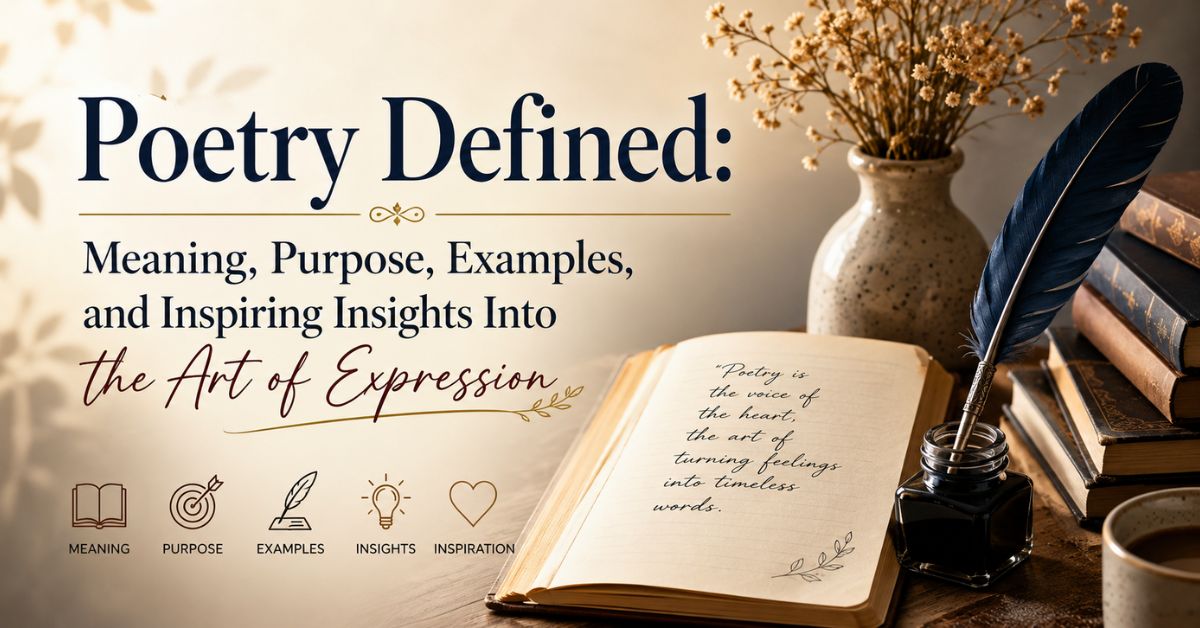
Poetry has existed for thousands of years, yet many people still ask a simple question: What is poetry? Understanding poetry defined goes beyond memorizing a textbook definition. Poetry is one of humanity’s oldest and most powerful forms of expression. It transforms emotions, thoughts, experiences, and observations into carefully crafted language that resonates deeply with readers and listeners.
Unlike ordinary writing, poetry often uses rhythm, imagery, symbolism, and emotion to communicate ideas in a memorable way. A few lines of poetry can capture feelings that pages of explanation cannot. Whether found in ancient literature, modern spoken word performances, song lyrics, or personal journals, poetry continues to inspire people across generations.
In this guide, we’ll explore poetry defined in simple terms, examine its purpose, discuss its major characteristics, and discover why poetry remains relevant in today’s world. You’ll also find an exclusive collection of original quotes and practical life lessons that highlight the timeless value of poetic thinking.
What Is Poetry? Poetry Defined
At its core, poetry is a literary art form that uses language creatively to express emotions, ideas, experiences, and observations.
Poetry differs from ordinary prose because it often focuses on rhythm, sound, imagery, and deeper meaning. Rather than simply communicating information, poetry aims to create an emotional or imaginative experience.
A simple way to understand poetry defined is this:
Poetry is the art of saying more with fewer words.
Poets carefully choose each word to evoke feelings, paint pictures in the reader’s mind, and encourage reflection. Sometimes poetry follows strict patterns and structures. Other times it breaks traditional rules entirely.
Regardless of form, poetry seeks to connect people through shared human experiences.
The Purpose of Poetry
Poetry serves many purposes depending on the writer’s intentions.
Emotional Expression
Poetry allows people to express feelings that may be difficult to explain through everyday language. Love, grief, joy, hope, and fear often become more understandable through poetic expression.
Storytelling
Many poems tell stories, preserving history, culture, and personal experiences.
Inspiration
Poetry motivates readers to think differently, dream bigger, and find meaning in life’s challenges.
Reflection
Poems encourage introspection and help people understand themselves and the world around them.
Artistic Beauty
Sometimes poetry exists simply to celebrate the beauty of language.
Key Characteristics of Poetry
While poetry comes in many forms, several characteristics commonly appear.
Imagery
The senses are appealed to by poets through descriptive language.
Example:
“The golden sunlight spilled across the quiet lake.”
Readers can visualize the scene immediately.
Rhythm
Many poems create musical patterns through word choice and sentence structure.
Symbolism
Objects or ideas often represent deeper meanings.
For example:
- A journey may symbolize personal growth.
- A storm may symbolize struggle.
- A sunrise may symbolize hope.
Emotion
Poetry often prioritizes emotional impact over factual explanation.
Brevity
Poets frequently communicate profound ideas using surprisingly few words.
Different Types of Poetry
Understanding poetry defined also means recognizing its many forms.
Lyric Poetry
Expresses personal emotions and feelings.
Narrative Poetry
Tells a story through poetic language.
Free Verse
Does not follow strict rhyme or meter patterns.
Haiku
A traditional Japanese form known for simplicity and nature-focused imagery.
Sonnet
A structured poem often exploring themes of love, beauty, or reflection.
Spoken Word Poetry
Designed primarily for live performance and emotional engagement.
Why Poetry Still Matters Today
Some people assume poetry belongs only in classrooms and literature books. In reality, poetry remains deeply relevant.
Modern poetry appears in:
- Social media posts
- Music lyrics
- Motivational speeches
- Journaling practices
- Personal development content
- Mental health discussions
Poetry helps people slow down and notice meaning in everyday experiences. In a fast-paced digital world, that ability is more valuable than ever.
Original Quotes Collection
Quotes About Growth
| # | Quote | Meaning |
| 1 | Growth begins when comfort stops making decisions for you. | Progress requires courage. |
| 2 | Every lesson hidden inside failure becomes tomorrow’s strength. | Mistakes create wisdom. |
| 3 | Small improvements quietly build extraordinary futures. | Consistency matters. |
| 4 | Growth is often disguised as inconvenience. | Challenges help development. |
| 5 | The person you become is shaped by the habits you repeat. | Daily actions matter. |
| 6 | Change feels heavy until it becomes your new normal. | Adaptation takes time. |
| 7 | Personal growth starts where excuses end. | Accountability drives success. |
| 8 | Each difficult season teaches a skill comfort never could. | Hard times build character. |
| 9 | Growth requires patience with the process and faith in the outcome. | Trust long-term progress. |
| 10 | The strongest roots develop beneath unseen ground. | Real growth is often invisible. |
Quotes About Motivation
| # | Quote | Meaning |
| 11 | Motivation grows when action comes before confidence. | Start first, confidence follows. |
| 12 | Dreams move closer when excuses move away. | Commitment matters. |
| 13 | Every meaningful journey begins with an imperfect step. | Progress beats perfection. |
| 14 | Determination survives long after excitement fades. | Discipline sustains goals. |
| 15 | Success often belongs to those who continue when others pause. | Persistence wins. |
| 16 | Your future listens carefully to today’s choices. | Decisions shape outcomes. |
| 17 | Effort is the language ambition speaks fluently. | Hard work reveals goals. |
| 18 | Momentum is built by showing up repeatedly. | Consistency creates progress. |
| 19 | Action transforms possibility into reality. | Doing matters most. |
| 20 | The best time to begin is before certainty arrives. | Don’t wait forever. |
H3 Quotes About Success
| # | Quote | Meaning |
| 21 | Success grows from discipline more than talent. | Habits matter greatly. |
| 22 | Achievement follows preparation more often than luck. | Readiness creates opportunities. |
| 23 | Success becomes meaningful when shared with others. | Community adds value. |
| 24 | True success includes peace, not just accomplishment. | Balance is important. |
| 25 | Consistent effort quietly defeats occasional brilliance. | Persistence wins over time. |
| 26 | Success is built one decision at a time. | Small choices matter. |
| 27 | The strongest victories begin with self-belief. | Confidence is foundational. |
| 28 | Success rewards those who respect the process. | Trust the journey. |
| 29 | Growth and success travel the same road. | Improvement leads to achievement. |
| 30 | Meaningful success leaves a positive impact behind. | Legacy matters. |
Quotes About Life Lessons
| # | Quote | Meaning |
| 31 | Life teaches quietly before it teaches loudly. | Notice early lessons. |
| 32 | Gratitude reveals abundance hidden in ordinary moments. | Appreciation changes perspective. |
| 33 | Wisdom often arrives wearing the clothes of experience. | Learning comes through living. |
| 34 | The way you respond matters more than what happens. | Attitude influences outcomes. |
| 35 | Kindness creates echoes long after words disappear. | Positive actions last. |
| 36 | Time exposes what truly deserves attention. | Priorities become clear. |
| 37 | Patience allows important things to mature naturally. | Good things take time. |
| 38 | Life becomes richer when curiosity replaces judgment. | Open-mindedness encourages growth. |
| 39 | Every ending quietly prepares a new beginning. | Change creates opportunity. |
| 40 | The simplest truths often have the greatest impact. | Wisdom is often uncomplicated. |
How Poetry Influences Human Emotion
One reason poetry remains powerful is its emotional reach.
Poetry helps readers:
- Process difficult experiences
- Understand complex emotions
- Find comfort during challenges
- Celebrate meaningful moments
- Develop empathy toward others
A well-written poem often creates a connection between writer and reader that feels deeply personal. Even when written centuries ago, poetry can speak directly to modern experiences.
Poetry and Creative Thinking
Poetry encourages people to think beyond literal meanings.
When reading poetry, individuals learn to:
- Interpret symbols
- Recognize patterns
- Explore multiple perspectives
- Appreciate language nuances
- Develop imagination
These skills extend beyond literature and support creativity in everyday life, education, and professional environments.
Why This Topic Matters
Understanding poetry defined is about more than studying literature. Poetry teaches us how language shapes emotions, memories, and perspectives.
In a world dominated by quick communication, poetry reminds us of the value of thoughtful expression. It encourages deeper listening, greater empathy, and stronger emotional awareness.
Poetry also demonstrates that ordinary experiences can hold extraordinary meaning. A sunset, conversation, challenge, or personal triumph can become a source of inspiration when viewed through a poetic lens.
By exploring poetry, readers develop a richer appreciation for language and a stronger connection to their own thoughts and feelings.
Practical Life Lessons From Poetry
- Pay attention to everyday moments; inspiration often hides there.
- Choose words carefully because language shapes perception.
- Embrace emotions rather than avoiding them.
- Find beauty in simplicity.
- Practice reflection regularly.
- Value creativity as a tool for personal growth.
- Learn from different perspectives.
- Appreciate silence as much as speech.
- Allow challenges to become sources of wisdom.
- Express gratitude through writing and reflection.
Conclusion
Understanding poetry defined opens the door to one of humanity’s most enduring forms of artistic expression. Poetry combines emotion, imagination, and language to create meaningful experiences that resonate across cultures and generations.
Whether you’re reading classic literature, exploring modern spoken word performances, or writing your own verses, poetry offers a unique way to understand life and communicate ideas. By appreciating poetry’s purpose, forms, and influence, we gain a deeper connection to language and to the experiences that shape us. Poetry remains relevant because it continues to help people find meaning, inspiration, and beauty in both extraordinary and ordinary moments.
Poetry is a creative form of writing that uses carefully chosen words to express emotions, ideas, experiences, and observations in meaningful ways.
Poetry helps people communicate emotions, understand experiences, inspire creativity, and connect with others through shared human feelings.
Common elements include imagery, rhythm, symbolism, emotion, sound patterns, and figurative language.
No. Many modern poems use free verse and do not follow rhyme patterns. Poetry can be effective with or without rhyme.
Prose follows ordinary sentence structures used in books and articles, while poetry often emphasizes rhythm, imagery, and emotional impact.

Muhammad Ahad — Passionate writer sharing informative, engaging, and easy-to-read articles across different topics. Focused on delivering valuable content that helps readers learn, explore, and stay inspired every day.
1 thought on “Poetry Defined: Meaning, Purpose, Examples, and Inspiring Insights Into the Art of Expression”